
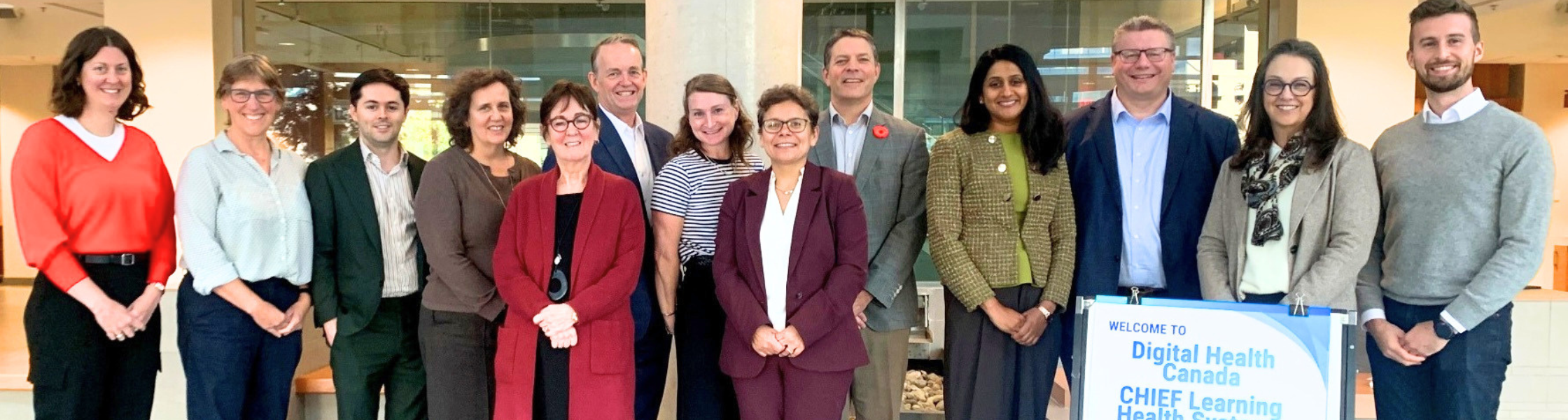
CHIEF Executive Forum Learning Health System Working Group members explore what it takes to assess and strengthen learning capabilities across Canadian healthcare.
What happens when you bring together healthcare leaders, researchers, digital health experts, and a patient partner to test what it means to be a Learning Health System?
On October 29, 2026, members of Digital Health Canada’s CHIEF Executive Forum Learning Health Systems (LHS) Working Group, co-led by Dr. Ted Scott of Hamilton Health Sciences and Dr. Geetha Mukerji of Women’s College Hospital, gathered at Hamilton Health Sciences’ David Braley Research Institute for a hands-on workshop focused on a practical challenge: how can healthcare organizations assess their capacity to continuously learn and improve?
The session brought together representatives from Hamilton Health Sciences, Healthcare Excellence Canada, BORN Ontario, Trillium Health Partners, Amplify Care, Women’s College Hospital, CANImmunize, and Alliance for Healthier Communities, alongside a patient partner. Participants brought perspectives spanning clinical care, research, quality improvement, digital health, data infrastructure, and health system transformation.
The objective was not simply to discuss what makes a Learning Health System, but to test a draft maturity assessment tool against real-world examples and identify what would make it useful for healthcare organizations across Canada.
From a national scan to a practical tool
The workshop built on the working group’s national environmental scan, which identified 65 Canadian initiatives demonstrating Learning Health System characteristics, complemented by examples from the literature.
The scan revealed considerable activity across the country, but also significant variation in how learning is organized, supported, and sustained. While many initiatives demonstrate elements of continuous learning, these capabilities are not always integrated across clinical care, research, data, and operational decision-making.
This raised an important question: How can organizations understand where they are today and identify what they need to strengthen to become more effective Learning Health Systems?
To begin answering that question, the working group developed a draft LHS Maturity Self-Assessment Tool covering six domains:
- Science, Data and Informatics
- Patient–Clinician Partnership
- Continuous Learning Culture
- Incentives and Sustainability
- Structure and Governance
- Equity and Ethics
The tool is intended to support reflection and improvement, not to rank organizations.
Putting the framework to the test
The heart of the workshop was a hands-on exercise using three very different Canadian examples.
- Hamilton Health Sciences’ Breast Cancer Learning Health System demonstrated how clinical expertise, data engineering, and research can come together to transform routine care data into knowledge that supports clinical and operational improvement.
- Healthcare Excellence Canada’s long-term care improvement work offered a different perspective: how a national organization can support learning across participating care organizations through coaching, collaboration, evaluation, and the spread of effective practices.
- BORN Ontario’s Prenatal Screening Ontario program illustrated learning at a provincial scale, connecting screening data, quality monitoring, practitioner feedback, and evidence-informed policy decisions to improve prenatal screening services.
The differences between the cases were intentional. A framework designed to support Learning Health Systems across Canada needs to work in different organizational settings, not just within individual hospitals or clinical programs.
Participants worked in small groups, first assessing their assigned case individually and then comparing their interpretations and scores.
What did we learn?
The three cases sparked lively discussions about what it really means to be a Learning Health System and how organizations can assess their progress.
Participants explored questions about the different levels at which learning happens, how to recognize organizational and system-level barriers, and how to ensure the assessment supports meaningful improvement rather than simply producing a score.
The exercise also reinforced the importance of collaboration, patient and community partnerships, and translating knowledge into action.
Where do we go from here?
The feedback from the workshop will inform the next iteration of the maturity assessment tool, including clearer guidance on what is being assessed, how indicators should be interpreted, and how results can support meaningful improvement.
The working group’s broader ambition is to translate insights from the environmental scan, literature, and real-world implementation experiences into practical resources that help Canadian healthcare organizations advance their learning capabilities.
A Learning Health System is not simply one that generates knowledge. It is one that can consistently turn that knowledge into better care—and keep learning from what happens next.
Thank you to Hamilton Health Sciences for hosting the workshop at the David Braley Research Institute, and to all participants for sharing their expertise, experiences, and thoughtful feedback.
Have an idea? We’d love to hear from you!
Have an idea for a resource or a new working group? We’d love to hear about it! Contact us at CHIEF@digitalhealthcanada.com.
Pictured, from left to right:
- Laura Desveaux (Trillium Health Partners Director, Learning Health System Leadership Centre)
- Jennifer Rayner (Alliance for Healthier Communities Director, Research & Policy)
- Cameron Bell (CANImmunize CEO & Co-founder)
- Andrea Eisen (Hamilton Health Sciences Medical Oncologist and Scientist)
- Nancy Fenton (Patient Partner)
- Ted Scott (Hamilton Health Sciences Chief Innovation Officer)
- Marissa Binstock (Digital Health Canada Senior Manager, CHIEF Program + Strategic Initiatives)
- Christine LaRoque (Healthcare Excellence Canada VP, Operations & Impact)
- Ted Alexander (Amplify Care VP, Partnerships and Clinical Information)
- Geetha Mukerji (Staff Endocrinologist and Clinician in Quality and Innovation and Associate Professor, University of Toronto and Women’s College Hospital Institute of Health Systems and Virtual Care (WIHV))
- Tim Dietrich (Hamilton Health Sciences VP, Quality & Performance)
- Shelley Dougan (BORN Ontario Director, Prenatal Screening Ontario & Complex Perinatal)
- Jonathan Ranisau (Hamilton Health Sciences Manager, Data Science and Data Engineering)