

Members

Member Organizations

Followers

Credential Holders

Webinar Wednesdays

Active Volunteers

President and CEO, Carveira Group Consulting Inc.

Director, Hospital Data Transformation, Canadian Institute for Health Information (CIHI)

Practice Lead, Strategy & Implementation, Stratford Group

Manager, Data Standards, Canadian Institute for Health Information

Chief Executive Officer, Amplify Care

Vice President, Professional Practice, Chief Nursing & Allied Health Officer, and Chief Clinical Information Officer, Vancouver Coastal Health

Vice President of Strategy, Digital Health and Chief Digital Officer, North York General Hospital

Director, eHealth Strategy and Governance, Alberta's Primary and Preventative Health Services

Professor of Medical Informatics, Faculty of Medicine, Dalhousie University

Founder, Blue x Blue Inc.

Director, Provincial Technology Services, Alberta Health Services

CEO, Digital Health Canada

Executive Director, Digital Health Canada
"The future of healthcare will be shaped not only by technology, but by collaboration, trust, and shared purpose. We are proud to work with this remarkable community as we continue leading Canada’s digital health future — together."
On behalf of the Board Development Committee (BDC), I am pleased to provide this report on the Committee’s activities during the 2025–2026 governance year.
The Board Development Committee (Duska Kennedy (Chair), Chris Carvalho, Cassie Frazer, Sophia Hoosein, Shelagh Maloney ex-officio, Shannon Bott
ex-officio) was established to support the Board of Directors in fulfilling its responsibilities related to board recruitment, succession planning, board development, evaluation, and governance excellence. During the past year, a significant focus of the Committee’s work was the implementation of Digital Health Canada’s refreshed board nomination and selection process, following governance and by-law changes approved by the membership.
Board Recruitment and Director Selection
This year marked the first application of the organization’s new competency-based board recruitment and selection framework. Consistent with the Board Development Committee’s Terms of Reference, the Committee undertook a review of Board composition, competencies, succession requirements, and strategic priorities before launching the annual recruitment process.
The Committee reviewed the Board competency matrix and identified priority areas for recruitment, including governance and leadership experience, clinical and healthcare delivery expertise, emerging technology and innovation, professional development and mentorship, and national representation. Particular attention was paid to ensuring that Board composition continues to reflect the diversity of Canada’s digital health community and supports the long-term strategic needs of the organization.
To support execution of the recruitment process, the Board Development Committee established and oversaw an ad hoc Nominating Committee, Chaired by the Past-President. The Nominating Committee was tasked with managing the operational aspects of the process, including candidate review, shortlisting, interviews, and development of a recommended slate of nominees.
Due Diligence and Oversight of the Selection Process
As the first year under the new governance model, the Committee focused on ensuring a fair, transparent, and competency-based selection process. The Committee provided oversight and direction regarding:
The Nominating Committee reviewed all eligible applications using a structured evaluation framework aligned with Board priorities and the competency matrix. Candidate assessments considered governance experience, strategic leadership capability, sector representation, geographic diversity, diversity of perspective, demonstrated commitment to Digital Health Canada, and alignment with the organization’s mission and values.
A notable feature of the revised process was the introduction of a formal review mechanism for incumbent directors seeking an additional term. Consistent with the Committee’s mandate to support informed succession planning and Board effectiveness, incumbents were not automatically advanced. Rather, each incumbent was assessed based on attendance, engagement, committee participation, advocacy, contribution to Board discussions, and alignment with future Board needs.
The Committee was satisfied that this approach appropriately balanced continuity with accountability and reflected good governance practice.
For candidates competing for open positions, interviews were conducted using a standardized interview framework. Independent interviewer assessments were completed and considered alongside competency requirements and Board composition needs. Additional due diligence was incorporated through direct discussion of potential conflicts of interest and competing organizational affiliations. Where potential conflicts were identified, candidates provided assurances regarding recusal or resignation from conflicting roles should they be elected.
Following completion of the process, the Board Development Committee reviewed the Nominating Committee’s recommendations and was satisfied that the process had been conducted consistently, fairly, and in accordance with the approved governance framework and the Committee’s Terms of Reference.
Board Succession and Composition
The Committee was encouraged by the calibre, diversity, and breadth of experience represented across the applicant pool. A total of twenty-one applications were received, resulting in a highly competitive selection process.
In reviewing the recommended slate, the Committee considered not only individual qualifications but also overall Board composition, including governance continuity, regional representation, public and private sector perspectives, clinical expertise, digital health leadership, innovation capability, diversity of thought, and future succession needs.
The resulting slate reflects a thoughtful balance of continuity and renewal while strengthening the Board’s collective competencies and national perspective.
Board Development and Governance
In addition to recruitment activities, the Committee continued its work to strengthen governance practices and Board effectiveness. During the year, the Committee reviewed and updated its Terms of Reference to align with the organization’s evolving governance framework and to formalize responsibilities related to director evaluation, succession planning, onboarding, and leadership development.
The Committee also began planning enhancements to director onboarding and succession planning processes to support future Board and committee leadership transitions.
Lessons Learned
The Committee is confident that the recommended slate positions Digital Health Canada for continued success and reflects the organization’s commitment to strong, transparent, and member-driven governance. Lessons learned from this year’s process will be used to further refine future recruitment cycles, strengthen succession planning, and enhance opportunities for member engagement in governance and volunteer leadership roles.
The Board Development Committee would like to thank the members of the Nominating Committee (Owen Adams, Cassie Frazer, Elaine Huesing, Raj Malik, Gillian Sweeney) for their diligence, professionalism, and commitment throughout the recruitment process. Their work contributed significantly to the successful implementation of the new framework and to the identification of a strong slate of candidates for Board service.
Respectfully submitted,
Duska Kennedy
Chair, Board Development Committee, Digital Health Canada
"Excellent speakers, good layout, great food and drinks, appreciate the topics!" - 25-26 event attendee
Events
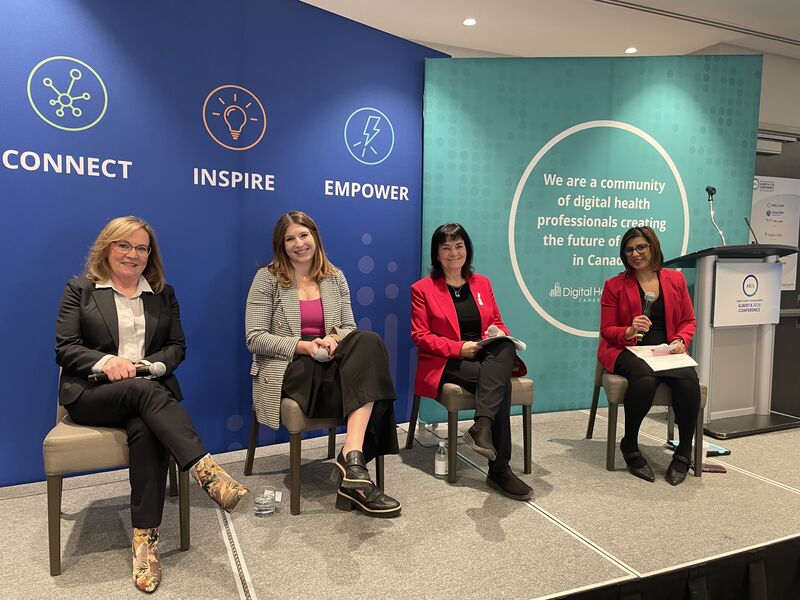
In 2025-2026, Digital Health Canada connected with digital health professionals at 53 events (virtual and in-person), offering networking, inspiring speakers and presenters, and the empowerment that comes with continuous learning and professional development. Events held in the 2025-2026 calendar year include e-Health25 in Toronto; breakfast events in Winnipeg and Montreal; CHIEF Executive Forum Symposia; regional conferences in the Atlantic region, Saskatchewan, Alberta, British Columbia, and Ontario; and post-conference Meet-up events in each region. Additionally, Digital Health Canada members presented 37 Wednesday Webinars throughout the year.
The 2025 fiscal year marked the inaugural year of the Board Governance Committee (BGC). Struck as a new standing committee this year, our focus was to strengthen the framework that guides Digital Health Canada—ensuring robust Board oversight, clear accountability, and stronger alignment between Board operations and organizational strategy. It was an incredibly active first year, taking us from initial research and analysis all the way to full implementation on several major initiatives.
Key Accomplishments
The Year Ahead
Now that the Board Development Committee has officially launched, the BGC will focus on strengthening our core functions under our revised terms of reference. In the coming year, our priorities will be putting our new risk management framework into action, continuing our systematic review of governance policies, and updating by-laws where needed.
Cassie Frazer
Past-President, Chair Governance Committee Digital Health Canada
"[One of most valuable aspects was] hearing the input of one of the other members ... and how they saw the content tie into their current work." - Informatics Now Live Learning Attendee
Learners
In 2025-2026, Digital Health Canada offered two Informatics Now Live Learning courses facilitated by expert Digital Health Canada members who volunteer their time and talent to further knowledge of health informatics. The Informatics Now Live Learning Series is open to learners who want to deepen their knowledge of health informatics, prepare for the CPHIMS-CA exam, or explore the Canadian digital health ecosystem under the guidance of expert facilitators.
For learners who prefer to set their own pace, Digital Health Canada’s self-directed learning content is delivered in pre-recorded modules that can be purchased individually or in one package. Together they form the Core Health Informatics Course. The course equips learners with the essential knowledge and skills to effectively manage and utilize health information within the healthcare sector. By completing these courses, learners are well-prepared to contribute to the improvement of healthcare delivery through the effective use of information and technology.
I am pleased to present the audited financial statements of Digital Health Canada for the fiscal year ended March 31, 2026.
The Audited Financial Statements are available for member review on pages 7–17 of this report.
The organization continues to maintain a strong financial position, delivering another year of positive operating results while investing in programs, professional development, member services, and the ongoing success of the eHealth Conference and Tradeshow.
For the year ended March 31, 2026, Digital Health Canada reported total revenues of $3.95 million and total expenses of $3.71 million, resulting in an excess of revenues over expenses of $238,684. This follows a surplus of $247,110 in the previous fiscal year and reflects continued financial stability and prudent management of resources.
Net assets increased from $649,008 to $886,692 during the year, strengthening the organization’s financial foundation and enhancing our ability to invest in future strategic initiatives. Unrestricted net assets grew to $861,004, while the Steven Huesing Scholarship Fund maintained a balance of $25,688 after awarding scholarships to support students pursuing studies in health informatics.
The organization’s financial position remains strong. As of March 31, 2026, Digital Health Canada held cash and investments totaling $3.06 million, compared with $2.27 million in the prior year. These funds provide the liquidity necessary to support ongoing operations, future conference activities, and strategic opportunities. Investments continue to be held in accordance with the Board-approved investment policy, emphasizing capital preservation through federally or provincially backed instruments and Canadian Deposit Insurance Corporation– insured investments.
Membership services remained a significant source of revenue, contributing approximately $951,000 during the year. Conference and event activities generated $554,000 in revenue, while training, education, thought leadership, and corporate services programs continued to support both our mission and financial sustainability.
The eHealth Conference remains an important contributor to the organization’s success. The 2025 conference generated revenues of $2.32 million and produced a positive financial contribution after expenses. At year-end, the organization had also collected $1.84 million in deferred revenue related to the upcoming 2026 conference, reflecting strong industry engagement and support.
The auditors, Kriens LaRose LLP, have issued an unqualified audit opinion, confirming that the financial statements present fairly, in all material respects, the financial position of Digital Health Canada in accordance with Canadian accounting standards for not-for-profit organizations.
On behalf of the Board of Directors, I would like to thank this years’ Finance and Audit Committee (Mohamed Alarakhia, Lorraine Blackburn and Wendy Tegart), management team, staff, volunteers, members, sponsors, and conference partners whose contributions continue to support the organization’s success. Their commitment enables Digital Health Canada to advance its mission of connecting, inspiring, and educating the digital health professionals who are shaping the future of healthcare in Canada.
Respectfully submitted,
Shannon O’Connor Secretary-Treasurer Digital Health Canada
“I really appreciated the detailed information and especially the implementation checklist and the case examples highlighting the importance of not only the technology but also the context.” - Early user
Toolkit visitors
In 2025-2026, Digital Health Canada made available to the public the Clinical AI Toolkit, a detailed toolkit supporting consistent, practical, and scalable assessment of AI implementations across Canadian healthcare settings. The toolkit brings together key elements needed to evaluate early impact, interpret results, and support responsible scaling. It provides a minimum evaluation that any organization can use, including those with limited analytic capacity, along with optional expanded components for teams that wish to conduct deeper analysis.
The Clinical AI Toolkit exemplifies how Digital Health Canada members volunteer their time and expertise to produce living resources that contribute to the digital health body of knowledge, spur discussion, and shed light on key issues.
as at March 31, 2026
| 2026 | 2025 | |
| $ | $ | |
| Assets | ||
|---|---|---|
| Current | ||
| Cash | 558,251 | 650,409 |
| Investments | 2,501,073 | 1,615,649 |
| Accounts receivable | 6,180 | 11,352 |
| Prepaid expenses - e-Health Conference | 160,195 | 306,295 |
| Prepaid expenses - Other | 19,459 | 21,916 |
| 3,245,158 | 2,605,621 | |
| Liabilities | ||
| Current | ||
| Accounts payable and accrued liabilities | 118,855 | 95,399 |
| Government remittances payable | 99,952 | 126,192 |
| Deferred revenue | 302,064 | 299,516 |
| Deferred revenue - e-Health Conference | 1,837,595 | 1,435,506 |
| 2,358,466 | 1,956,613 | |
| Net Assets | ||
| Unrestricted net assets | 861,004 | 622,320 |
| Scholarship Fund | 25,688 | 26,688 |
| 886,692 | 649,008 | |
| 3,245,158 | 2,605,621 | |