

Health informatics is a broad and evolving field. As digital technologies, health data, care delivery and the health system continue to change, so do the capabilities needed by the people working across Canada’s digital health ecosystem.
That’s why Digital Health Canada has refreshed its Health Informatics Professional (HIP®) Core Competencies Framework for 2026.
The refreshed framework retains the established seven-domain foundation while reflecting how health informatics practice has evolved. It provides a common language for the knowledge, skills, judgement and applied capabilities that support effective health informatics practice across Canada.
The 2026 refresh was informed by a review of existing research and competency frameworks, interviews with health informatics leaders and practitioners, community consultation, and expert validation. The result is an expanded framework of 68 validated competencies across seven established domains, reflecting the evolving demands of digital health practice.
Why refresh the competencies?
Health informatics professionals work at the intersection of health, information and management—and the nature of that work continues to change.
The 2026 framework uses more applied language to reflect how capabilities are being used in practice. Areas that may once have required general awareness increasingly require practical understanding across a broader range of roles.
The refresh also recognizes that some important capabilities don’t belong neatly within a single area of practice.
These cross-cutting capabilities include:
- AI literacy and responsible use
- Data governance and stewardship
- Equity-aware practice
- Human factors and usability
- Indigenous data sovereignty
- Interoperability
- Patient- and consumer-centred orientation
- Benefits realization
Embedding these capabilities throughout the framework reflects how digital health work happens in real-world settings rather than treating them as isolated areas of expertise.
Why do the competencies matter?
The HIP® Core Competencies Framework provides a common language for health informatics practice.
That common language can support conversations about:
- Workforce development – What capabilities does the digital health workforce need today—and as the field continues to evolve?
- Education – How can post-secondary programs and other learning opportunities align with digital health workforce needs?
- Professional growth – What capabilities do I have today, and where would further development help me in my current role?
- Career planning – What capabilities are relevant to the direction I want my career to take?
- Credentialing – How do core health informatics capabilities connect with professional certification and development?
The framework is intended to support all these conversations.
What has changed?
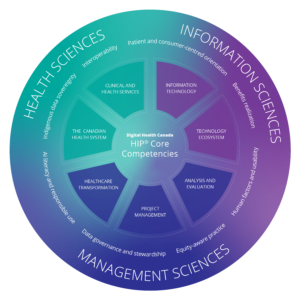 The seven-domain foundation remains, but the domains were re-ordered to put The Canadian Health System—the natural starting place—first. Additionally, the lettering and numbering of the domains and their respective competencies were simplified.
The resulting framework contains 68 validated competencies across the seven domains; an increase in the total number of competencies from 55 to 68. The refresh also identified eight cross-cutting practice capabilities that are embedded throughout the framework. The the HIP wheel diagram, shown here, was updated to include the cross-cutting themes and to visually suggest the inter-connected nature of the domains.
Who should use the framework?
The HIP®Core Competencies aren’t only for people with “health informatics” in their job title.
The framework is intended for a wide range of audiences, including:
- Health informatics and digital health professionals – Use the competencies to reflect on your current capabilities, identify development opportunities and support career planning.
- Students and emerging professionals – Use the framework to understand the breadth of health informatics and explore the capabilities that may be relevant to your career.
- Educators and post-secondary institutions – Use the competencies to consider how curriculum aligns with the needs of Canada’s digital health workforce.
- Employers and workforce planners – Use the framework to support conversations about roles, recruitment needs and professional development pathways.
- Health system partners – Use it to build a shared understanding of contemporary health informatics practice and the capabilities required across the health system.
How should you use it?
Start with the seven domains.
The refreshed framework brings together:
- A. Health Sciences
- The Canadian Health System
- Clinical and Health Services
- B. Information Sciences
- Information Management
- Technology Ecosystem
- C. Management Sciences
- Healthcare Transformation
- Project Management
- Analysis and Evaluation
Together, these domains represent the breadth of health informatics practice.
But the framework is intentionally role-agnostic and level-neutral. It is not a checklist requiring every professional to demonstrate the same depth in every competency.
Instead, consider the framework through the lens of your own role, setting, career stage and purpose.
You might use it to ask:
- Which areas are central to my current role?
- Where do I have strong capability?
- Where would additional knowledge or experience benefit me?
- Which competencies are becoming increasingly important in my area of practice?
- What professional development could help me build those capabilities?
Think breadth—and depth
One of the strengths of the framework is that it recognizes both the breadth of health informatics and the different ways professionals contribute to the field.
You don’t need to be a specialist in every competency.
You don’t need to be an AI specialist to benefit from the refreshed competencies. The framework helps professionals understand the capabilities relevant to their roles, recognize emerging responsibilities and identify where further learning or specialist expertise may be needed.
The framework can help you understand the wider landscape while identifying the areas where deeper expertise is most relevant to your work.
That makes it useful not only for individual professionals, but also for teams, organizations, educators and workforce planners.
How does it connect with Digital Health Canada’s other tools?
The HIP® Core Competencies Framework is one part of a broader set of Digital Health Canada resources.
The Career Matrix complements the framework by illustrating how capabilities may be reflected across roles, career pathways and levels of mastery.
Education and professional development resources can then help develop the knowledge, methods, examples and applications associated with those areas.
The competencies help identify relevant capabilities; the complementary resources can help you explore career pathways and develop those capabilities. Used together, these tools can support clearer career pathways, curriculum alignment, professional development planning and workforce conversations across Canada’s digital health ecosystem.
A framework for a changing profession
The 2026 refresh is not about replacing the foundation of health informatics. It is about ensuring that the framework continues to reflect the profession as it exists today.
The seven-domain foundation remains.
What has evolved is how health informatics professionals apply their knowledge and capabilities—and the range of issues they need to navigate, from AI and interoperability to data governance, equity, usability and responsible use of health information.
The refreshed HIP® Core Competencies Framework provides a shared foundation for understanding that work.
Explore the 2026 Health Informatics Professional Core Competencies Framework and consider how you can use it in your own career, organization or learning journey.